How Id Approach General Assembly Again as a Vc
It's no secret that the technology sector has a diversity problem. Fifty-fifty companies that have publicly pledged to diversify their workforces accept struggled to practice so: In July, Facebook revealed that only 4% of its employees were Hispanic and ii% black, unchanged from the previous year. The social network blamed the consequence on a lack of available talent—a claim that has consistently been disproved.
Only the arraign may non lie entirely with Mark Zuckerberg. "The practical realities and choices fabricated at the hiring level often supersede very positive and adept intentions, even when it's coming from the most senior executives" said Tom Ogletree, director of Social Touch on at General Associates.
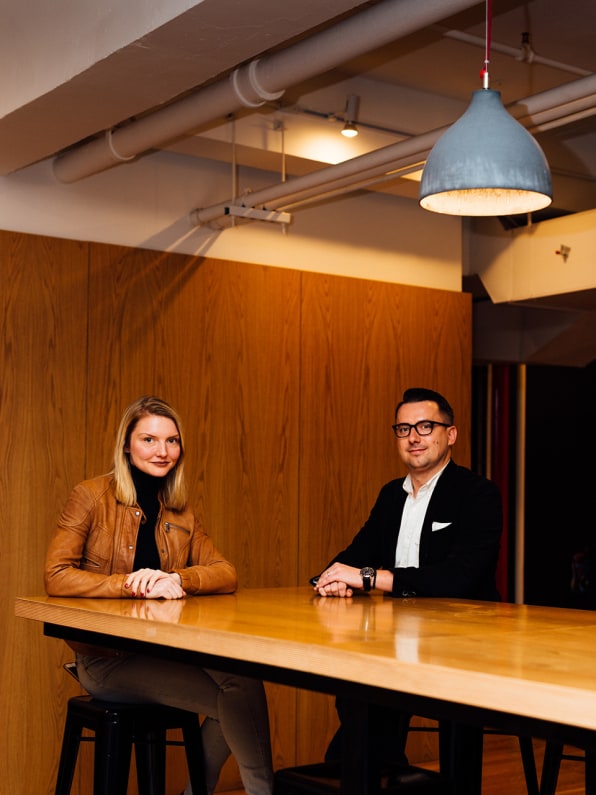
The popular ed-tech startup, which provides training for jobs in the digital economy, is hoping to alter that. At the Fast Visitor Innovation Festival earlier this calendar month, Ogletree and Anna Lindow, VP of Partnerships at General Assembly, or GA, described how the system is targeting employers' hiring practices and working with companies to interruption sometime habits.
"Nosotros're trying to exist influential in irresolute the mode that talent is sourced, assessed, trained, and developed," Lindow said. "We believe that the system, as it exists today, has limitations. We're not seeing a diversity of perspectives, and that gives us a world where everything that we're using has that sameness to it. It doesn't correspond the users."
Through scholarship programs, partnerships with metropolis, local, and federal governments, and alliances with nonprofits like Black Girls Code, GA is trying to empower low-income and minority communities to pursue careers in tech. But that's only half the battle. The side by side hurdle is getting those individuals in the door at tech companies, where old assumptions about higher degrees, work experience, and social groundwork oftentimes come up into play. To "blow up that acme xx school paradigm," every bit Lindow put it, she has devised three steps hiring managers can have.
Railroad train More Internally
"Recruiting is expensive," Lindow said. "Upskilling somebody is cheaper." Employers often waste fourth dimension waiting for the perfect candidate to apply for an open position, she explained. They'd be smart to take a risk on other promising applicants and teach them the skills they demand later. This is peculiarly true for entry-level employees. "You're going to teach them your fashion of doing things anyway," Lindow said. And past waiting for the dream employee to show up, companies may be passing on brilliant individuals who have plenty of potential, only simply oasis't had the aforementioned educational or employment opportunities.
Assess Talent Differently
Similarly, employers may be passing on candidates who take the skills to succeed, but don't have a traditional résumé. People who have managed a team at a retail store or a eatery, for case, may have strong leaderships skills, but are overlooked because of a lack of experience in the tech space. "Translating past experience, particularly without a higher degree, is really difficult for employers to wrap their heads around," Ogletree said. He and Lindow suggest evaluating candidates based on their skills, rather than their career or education history. To that stop, Ogletree'south team has been developing assessment tests for web evolution and digital marketing, which would score candidates based on their abilities, potentially eliminating unconscious bias and opening the door for skilled workers, regardless of how they caused those skills.
Look Somewhere Else
Companies that are struggling to notice diverse talent are often searching in the wrong places, according to Lindow. She compared the process to dating: Y'all might await for your partner at a bar, on Tinder, or through a friend. Merely employers' methods are alike to using a matchmaker and "limiting criteria down to people who are over six-pes-one, dearest cats, and detest turtles," she said. "There's a few people who are over 6-pes-ane, love cats, and hate turtles, and they're already working at Google." To discover a broader pool of candidates, Lindow suggests looking at organizations like General Associates, as well equally seeking out individuals in other fields or industries.
Ogletree and Lindow both stressed that variety isn't a buzzword and that these steps aren't just most checking boxes. "This isn't merely about being able to tell a good story at your company and to get good printing.," Lindow said. "It really is something deeper. It's about actually being able to do better business organisation because there's a diversity of perspective. It'due south virtually creating a ameliorate world in the long-term."
Source: https://www.fastcompany.com/3065128/how-general-assembly-is-helping-companies-increase-dive
0 Response to "How Id Approach General Assembly Again as a Vc"
Post a Comment